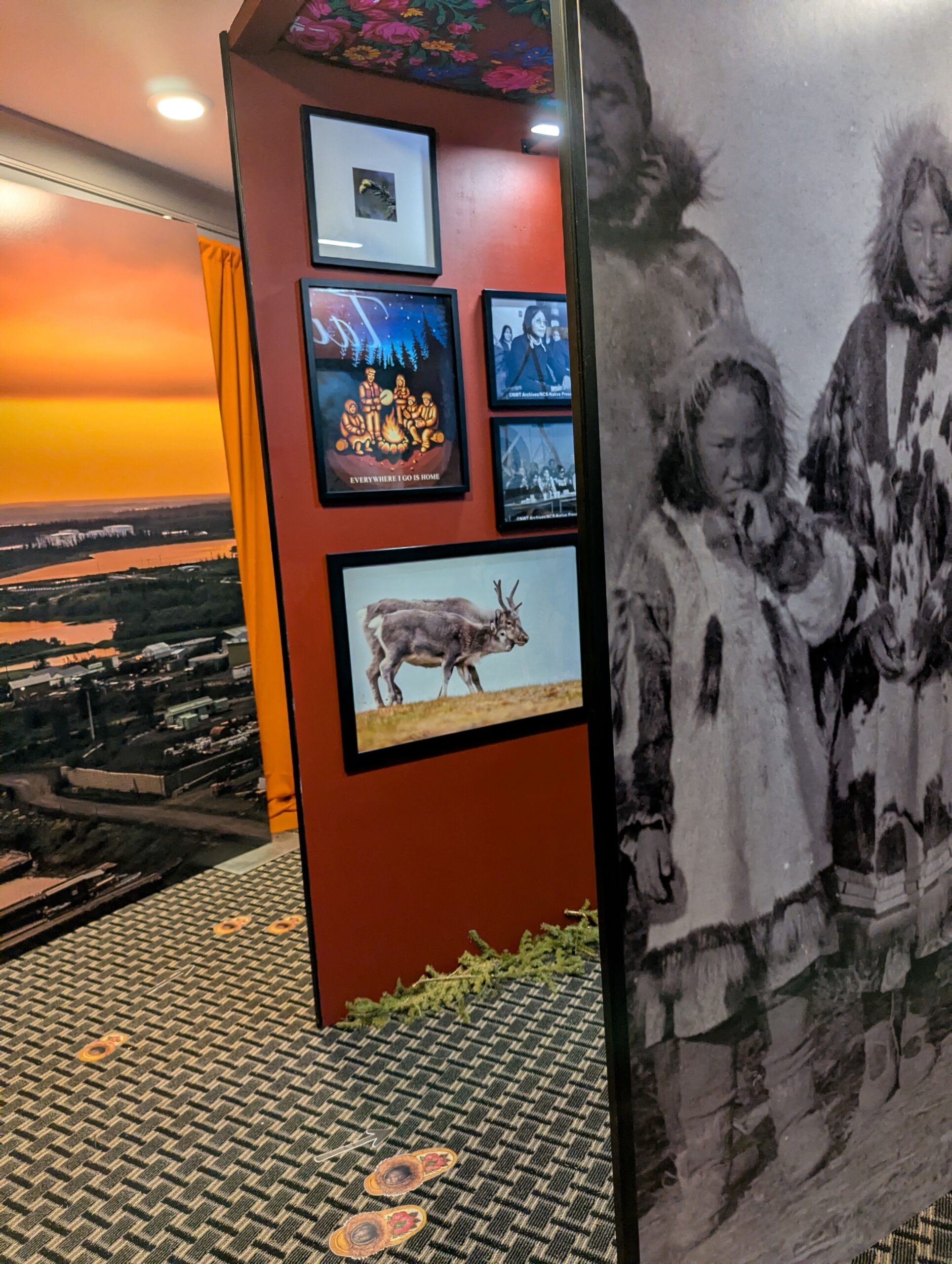
“Asking the system to work in a different way, we thought it would be well placed to also present the information in a different way.” Nina Larsson a lead organizer and director of Community, Culture and Innovation says the North Star, an interactive art exhibit, mobilizes storytelling, visual design, music and immersive spaces to engage in dialogues of cultural safety and anti-racism in health care.
The Learning Exhibit is being held at the site of a three day Summit in Yellowknife that brings together Indigenous leaders, including Elders and Knowledge Keepers, government leaders, health professionals and field experts to consider new care models based in Indigenous holistic ways of health and wellbeing.

The exhibit opens a “portal” to culturally safe spaces as foundations to holistic health where education, justice, housing, language, song, science and art are grounded in interconnectedness.
Among the many artists involved in creating the Learing Exhibit are Tanya Snow, Inuit throat singer and narrator, Crystal Gail Fraser, Gwichyà Gwich’in historian and scholar, Dr. Sara Komarnisky, settler writer and researcher, Tania Larsson, Gwich’in artist, Maslyn Kakfwi Scott, artist, Erika Doehring-Lafferty, manager of Cultural Safety and Anti-Racism Learning Initiatives, Kyla Wright, manager of Systemic Design and Integration and Nina Larsson.

The participatory, immersive exhibit was designed to help leaders and health care professionals better understand what transformations are needed to make culturally safe and equitable health care possible.
Participants of the Summit and members of the media took part in a cultural safety learning experience as part of Following the North Star: Primary Health Care Reimagined Together Health Co-design Summit.

Doehring-Lafferty explained that “two-eyed seeing” was one of the elements at work in the art space.
“One of the elements of the exhibit is we hear so often of two-eyed seeing one eye and two worlds, we hear one foot in both worlds, in the western world, in the Indigenous world. And for me, that’s always made me feel like a person divided. Even as somebody who’s Gwich’in and German, I’d like to be a whole person, no matter which world I’m walking within. And so with this exhibit, the invitation has also been for all of you with both feet to come in and to see a way that’s an Indigenous way, in an embodied way. And to be able to not just be in our head like we can be with academics.”

Doehring-Lafferty considered the ways that René Descartes philosophy of “I think therefore I am” emphasizes the thinking process as a ‘western’ “way of reality.”
“Whereas in the Maori they say ‘We belong and therefore we are and so it’s about relationship and it’s embodied,” she said.
While it was a first time for some to move and be with “two feet” in “another way.” Doehring-Lafferty reflected on the ways that for Indigenous people, this is “a way that’s always been there.”
Doehring-Lafferty said the Summit was a space for “thinking with both feet planted” towards what the future of healthcare can be, “without having to be divided.”
Debbie DeLancey, a health consultant with the Délı̨nę Got’ı̨nę Government and former deputy minister of Health and Social Services. DeLancey took part in the interactive art exhibit and said she experienced two “conflicting reactions” within the space – one being “overwhelming sadness.”

“We’ve known these things for years, we’ve known what’s wrong with the system. We talked about the NUKA model and a Circle of Care, and Indigenous ways of knowing, for years and years.”
DeLancey said that the exhibit was a source of hope because it was the first time she has seen Indigenous ways of knowing articulated this way “as a statement of GNWT policy.”

“I started to feel hopeful that maybe the commitment to co-designing with Indigenous governments, because we know so much of what’s on that beautiful final canvas can’t be done by a settler government alone. They can only be done by Indigenous communities for their residents and without resources and commitment from the settler government, that’s never happened. So, I ended up feeling very hopeful that here’s a beautifully expressed explanation of where we need to go and a commitment to work on that collaboratively.”
Dene Elder Paul Andrew spoke of the ways the art space responds to the ways that colonial policies and practices remain present in the health care system.
“Reconciliation for me is not a very good word because reconciliation suggests we go back to the prior relationship. And we’ve never had a good relationship with Canada. Indigenous people never had a good relationship with Canada,” said Andrew.

“Everything has always been to address the ‘Indian problem’ and so ‘Reconciliation’ doesn’t really address the issue for me,” he added.
The space of the exhibit helps bring awareness to the colonial history within the present, said Andrew.
“When you look at some of the policies and programs that we have, policies from 100 years ago still exist and they’re still a major part of the relationship. So I think that that is a really important part of that whole situation that we’ve got to remind the Indigenous people that we still have a lot of work to do and I think this, this really does address a lot.”

Sharla Greenland, senior advisor of Community and Indigenous Engagement spoke of the ways that the exhibit conveyed how within the healthcare system, a person with knowledge of two worlds can become “strong like two people,” a Tłı̨chǫ value.
Greenland said this is a value that Indigenous and non Indigenous people can both learn from in building better health care models.
The exhibit included immersive natural elements with special significance for participants.
“What I found most grounding was walking into the tent and the ah’ as we say in Gwich’in are the spruce bows that smell is something I’ve known all my life. I grew up muskrat trapping in tents like this and that smell grounded me, right from the start,” reflected Greenland.

Nicole Robinson, director for Northern and Indigenous Health with Healthcare Excellence Canada, said the space was a portal into “truly experiential learning.”
“The audio and the music, the singing and everything. So I’m really processing it as an experience,” said Robinson.
Charlotte Greenland and Willam Greenland, a Knowledge Keeper and wellness provider, each remembered Elders from photos featured in the exhibit. The memory of the Elders brought a deeper groundedness.
“And feeling hopeful too. We’re going to fix this. We’re going to make it good again we’re going to make it better for our people,” said Willam Greenland.
Doehring-Lafferty reflected on the ways that media can influence the freedom of narrative to emerge.
“When I think about the media, and I think about media relationship to this space, is that there are stories that we’ve all been told and it’s not about shame.”
“The stories in the room with the cycle that you walked through, those stories are reinforced through narrative. When we think about, when I think about UNDRIP, when I think about media, I think about – is silence a form of propaganda? When we hear certain stories and we don’t hear others?