

Recently released public data from 2023 shows that while green house gas emissions fluctuated across the N.W.T in response to economic activity and climate conditions, there was an “overall decline” in emissions since 2005. While the results show progress towards net zero goals, the N.W.T. continues to rely mainly on fossil fuels, which continue to be the source of nearly 100 per cent of its energy supply.
“Notably, in 2023, the NWT emitted approximately 22% fewer GHGs compared to 2005, which serves as the baseline for the 2030 territorial target,” said the report’s authors.
The year prior, the emissions had shown a rise.
“Territorial emissions increased by 0.6% between 2022 and 2023, with an increase in electricity emissions being one main contributor. This is explained by a decreased availability of hydropower, due to the low-water levels in the North Slave hydropower systems and the refurbishment of the Taltson hydropower facility in the South Slave, requiring NTPC to rely on diesel generators,” said the researchers.
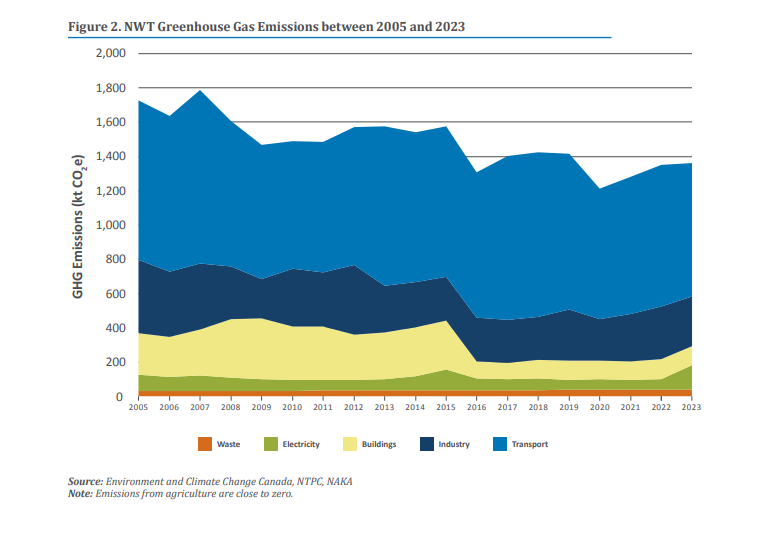
The news comes with the release of an energy report from the GNWT, that included their latest data sets on greenhouse gas emissions. The authors of the report noted that the transportation sector has “historically dominated” NWT’s emissions, with 2023 continuing this trend. The territory’s overall annual emissions were 1,360 kiltonnes of CO2 equivalent.
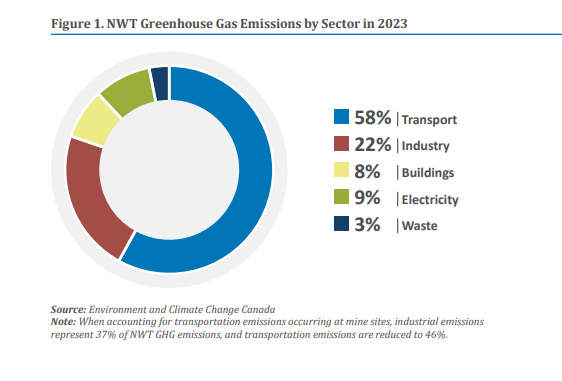
Transportation, building heating and power, and industrial activities using fossil fuels were found to be the source of the majority of emissions in the NWT. The data showed that transportation, mainly related to industrial activities, contributed 58 per cent of the territory’s emissions. On-site energy use in industry was responsible for 22 per cent of NWT’s emissions.
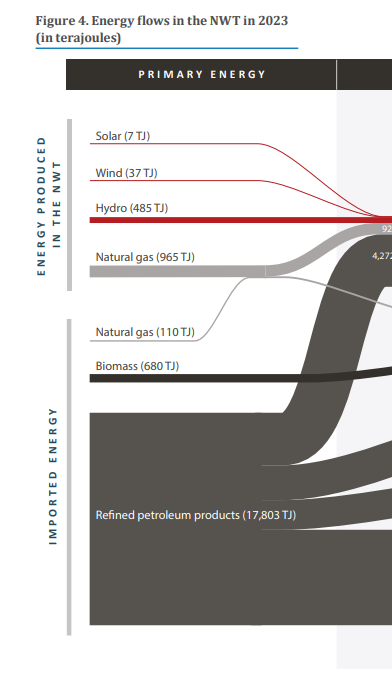
The N.W.T. continues to rely mainly on fossil fuels, which represent nearly 100 per cent of the energy supply.
“In 2023, the latest year for which data is available for this data source, the NWT’s primary energy supply amounted to 20,088 TJ. This represents the equivalent of approximately 500 million liters of diesel fuel. Fossil fuels were the main source of energy, accounting for 97% of the overall territorial energy supply,” said the researchers.