
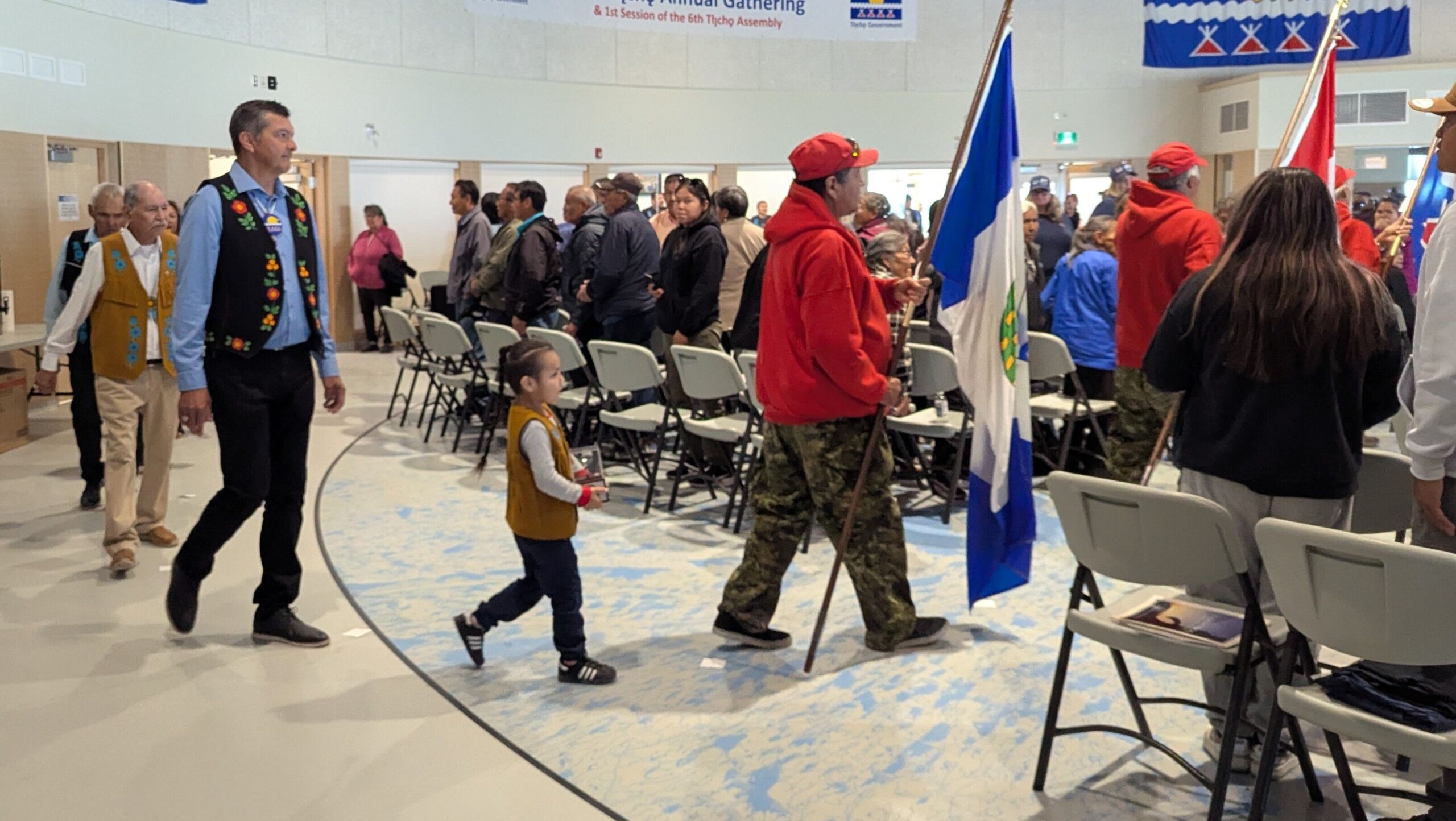

The Tłı̨chǫ Government presented a four-year priority plan focussed on goals of economic, housing, health and education sovereignty to advance a 50-year vision for the community.
The government drafted their priority plan following a workshop in Behchokǫ̀ last week where members of the Assembly met with the Department of Planning and Partnerships.
According to the announcement issued today, the four year plan focusses on economic self-sufficiency – including plans to advance the Arctic Economic Security Corridor, as well as housing and other infrastructure projects, healing and wellness programs to address addictions and capacity building in education and self-governance practices.
The priorities are aimed towards building a “strong, self-sustaining, and united people, deeply rooted” in language, culture, and traditions.”
Tłı̨chǫ leadership emphasized that education is a main part of this vision where language will taught in schools, homes, and community programs, and embedded in every aspect of daily life.
The Tłı̨chǫ Government plans to outline how these priorities can be advanced over the next four years. According to the announcement, the Tłı̨chǫ Government Plan will be published in Spring 2026 and presented at the Tłı̨chǫ Annual Gathering.
The priorities announced today were developed to advance the 50-Year Vision Statement.
“By 2075, the Tłı̨chǫ Nation will be a strong, self-sustaining, and united people, deeply rooted in our language, culture, and traditions, while thriving in a modern world”
The vision statement outlined strategic goals around culture, traditions, language, health, economic security, governance, education, land stewardship.
- Tłı̨chǫ yatıì is strong – spoken fluently by all generations, taught in schools, homes, and community programs, and embedded in every aspect of daily life.
- Our youth are empowered—supported by elders, educated in both Tłı̨chǫ and Western knowledge systems, and equipped to lead with pride, compassion, and skill.
- Our communities are healthy and safe—free from addiction, homelessness, and violence, with accessible treatment centers, wellness programs, and strong support systems.
- We are economically self-sufficient and locally driven—with Tłı̨chǫ-owned businesses, sustainable tourism, traditional economies, and infrastructure that generate wealth and opportunity for all citizens.
- Our governance is Tłı̨chǫ-led, inclusive and accountable—Tłı̨chǫ Government is led by Tłı̨chǫ and our governance is inclusive of all Tłı̨chǫ citizens, with transparent decision-making and meaningful engagement.
- Our land is protected and respected—with clean water, thriving wildlife, and active stewardship, on-the-land programs where Tłı̨chǫ knowledge is strong, and we are using our ancestral trails.
- Our infrastructure reflects Tłı̨chǫ nàowo —modern schools, hospitals, housing, and recreation centers built and maintained by our people, for our people.
- Our spirit is strong—with regular gatherings, ceremonies, and cultural celebrations that honor our past and inspire our future.
In August, the Tłı̨chǫ Government, led by Grand Chief Jackson Lafferty and the Tłı̨chǫ Assembly, with representatives from Behchokǫ̀, Gamètì, Wekweètì, and Whatì, and hundreds of Tłı̨chǫ citizens gathered for the 21st Annual Gathering and 1st Session of the 6th Assembly in Behchokǫ̀.
The gathering took place at the Behchokǫ̀ Culture Center from Aug. 11 to Aug. 14 and marked the 20 year anniversary.
During that gathering, significant new directions in self-governance and sovereignty were discussed geared towards a Tłı̨chǫ Nation-led education system rooted in Tłı̨chǫ community culture and traditions.
“Right now the Tłı̨chǫ government is negotiating to take over education, as we celebrate 20 years of the Tłı̨chǫl agreement. This is an important time for us and for our nation because we are ready to start taking over more control and have power over the future, especially for our kids,” said Sadetlo Scott, who is the Tłı̨chǫ Government’s director of Planning and Partnerships.
At the gathering, Sadetlo Scott, the Tłı̨chǫ Nation’s director of Planning and Partnerships, talked about plans to reclaim community culture and language for youth by taking strides to oversee their education system independently from the GNWT. Scott said the Tłı̨chǫ government is also negotiating to have more control over early childhood education.
Scott point out that the change, once implemented, would make the Tłı̨chǫ Government the first Indigenous government in the GNWT to reclaim control of their education system.