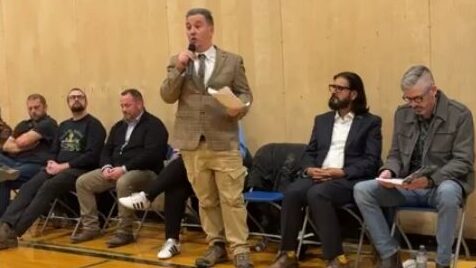

The candidates for City Council in the upcoming 2026 Yellowknife municipal election gathered on Tuesday for a forum to discuss what their priorities would be on the council.
20 of the 21 candidates were present at the forum. Vibhesh Tripathi, the final candidate, was reportedly out of town on the evening of the forum and was unable to attend.
Due to the large number of candidates in this election, each was only given a few minutes to speak on one of six issues as well as a lightning round where each candidate was given 5 seconds to provide a short answer to a question.
Robert Warburton, Simon Whitehouse, Nazim Awan, and Donna Lee Demarcke spoke on the issue of housing, land and how the city should decide what will be built where.
Demarcke spoke on the need for multi-use and multi-family constructions in the city, saying “I think we need a mix of everything.”
Whitehouse spoke on the loss of a number of housing units in the downtown area over the last decade and the need to replace them. “Apartment buildings, condominiums, developments that are close to the downtown core.”
Awan spoke about the need for more rental properties in the city, and about the downtown area, saying “We need to decide what we want to do about downtown.”
Warburton spoke on the role of zoning bylaws and the need to streamline the process of builders acquiring permits, saying “We shouldn’t be fighting lot by lot as we go through the city.”
Tammy Soanes-White, Keneisha Buddoo, and Jeremy Flatt spoke on growth and the city’s changing economy as mines wind down operations and significant defense investments are on the horizon.
Soanes-White spoke on Yellowknife’s history of cycles of ‘boom and bust’ and said the city should be cautious until federal investments materialize. “If we overspend now, we’re just going to enhance our cycle and the boom and bust will be worse than it has been in the past.”
Buddoo talked about the need to build up Yellowknife’s housing and infrastructure bases so that future investments can best benefit the residents of the city. “I think we’re forgetting the people. Who are we making Yellowknife ready for when all this money comes?”
Flatt spoke on his desire to protect the compactness and walkability of the city, and on the importance of a clear plan for how to grow the city. “What we need is clarity and confidence in our bylaws and community plan.”
Cody Drygeese, Roberta Marie Campbell, Skye Plowman, and Gerri Whiteford talked about the downtown area, homelessness, addiction, and where the territory’s responsibilities end and the city’s begin.
Drygeese said the city’s duty is to create more affordable housing in the downtown area, especially in light of the anticipated increase in population that will come with the upcoming federal investments. “We don’t have enough homes for the amount of people that are here already.”
Campbell spoke on the city’s role as a moderator, bringing the GNWT, NGOs, and other stakeholders to the table to discuss the city’s needs. “The territorial government, they’re responsible for our addictions. They need to start having an easier process for those that need to go out for treatment.”
Plowman advocated for a Downtown Ambassador Program to meet the homeless and addicted community where they’re at and be able to provide more effective aid. “A lot of the time people mostly just need someone to hear them and someone to see them.”
Whiteford spoke on the need for the city to collaborate closely with the territorial and federal government to address these kinds of issues in the city, as well as advocating for more beat cops in downtown Yellowknife. “I don’t see the city’s role beginning or ending.”
Fraser Fuite and Roland Laufer were asked about the city’s relationship with the Yellowknives Dene First Nation.
Fuite advocated for more permanent staff dedicated to discussions between the two governments and decried practices that slow down collaboration in the name of future leverage. “Constant collaboration for mutual benefit.”
Laufer said the city should listen to Indigenous knowledge holders, elders, and organizations as the city’s economy and community continue to evolve. “It should be a relationship where everybody’s on the same level.”
Adrian Bell, Yanik D’Aigle, and Rob Foote were asked about a decision made by the previous city council that they disagree with.
Bell provided the Community Plan Bylaw, which recently passed its second reading, as his example, saying it puts too much into the Frame Lake North neighborhood. “If you don’t have a plan b and maybe a plan c then you could be starting over from scratch.”
D’Aigle also gave the Community Plan as his example, saying it doesn’t do enough to encourage affordable homes to be built in the city. “It’s not focused enough, it’s not specific enough.”
Foote, who is a current member of the City Council, used the Community Plan as his example as well, saying he regrets voting for it to pass its second reading and that he found it too prescriptive. “I’d take that vote back now.”
Steve Payne, Andy Young, Rylund Johnson, and Ryan Fequet were asked the final question, concerning the rising cost of living and the city’s budget.
Payne proposed reaching out to businesses and changing the way the city approaches budgeting construction, as well as saying the city needs to change the way it thinks about taxes. “I would look at every dollar that we’re taxing as if it was our last dollar.”
Young said the city needs to change the way it constructs its budget, advocating for a top-down approach which would also include what council thinks the maximum tax increase should be. “We’re not going to get a decrease. The overall target would always be zero.”
Johnson said the city needs to be more careful about how tax dollars are spent, suggesting cuts to consultants and reports as a possible measure. “Council is entrusted with taxpayer dollars and those are sacred.”
Fequet praised changes to the budgeting process made by the previous council and advocated for more transparency and clarity regarding how much city services and facilities cost. “We don’t know what the value proposition of your taxes are.”
For the lightning round, candidates were first asked if the city should build housing on green space in established neighborhoods, with candidate answers ranging from a hard no to an unequivocal yes, as well as more nuanced answers.
“We’ve got to stop talking like there’s choice, we need all of it all at once,” said Robert Warburton.
Candidates were then asked if they would commit to serving their full term on City Council, not running for MLA in 2027. While not every candidate completely ruled it out as a possibility, each affirmed that Yellowknife was their top priority.
The final lightning round question was if the candidates would support no increases to property taxes in the next city budget. The vast majority of the candidates said that while they would prefer not to increase them, the budget would need to be flexible, and they couldn’t commit to zero increase.
The 2026 Yellowknife municipal election will be held on October 19. Information about polling locations as well as profiles for each of the candidates can be found on the City of Yellowknife website.