


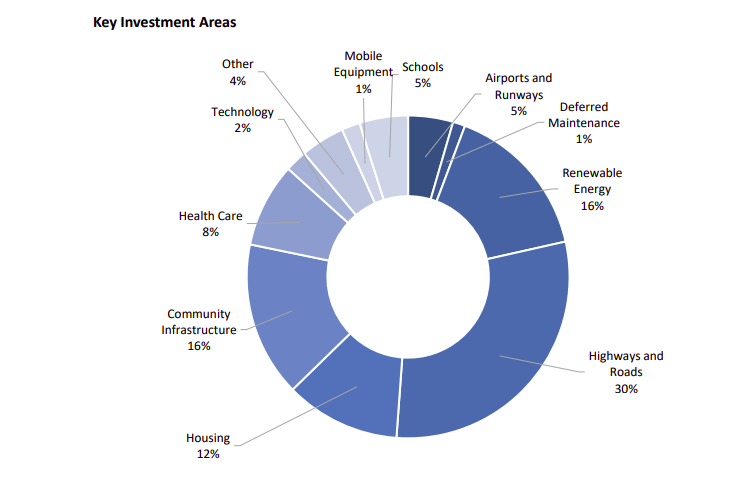

The GNWT’s proposed capital spending $436 million is concentrated heavily between the southernmost and northernmost regions. About 24 per cent of capital investments between 2026 to 2027, are aimed at the South Slave region and about 20 per cent at the Beaufort Delta region. The capital estimates report shows a focus on infrastructure development on highways and roads (30 per cent, about $130 million of total capital spending), community infrastructure (16 per cent, about $70 million), renewable energy (16 per cent, about $70 million) and housing (12 per cent, about $52 million).
“The capital investments are deliberately focused on creating employment and business opportunities for northern businesses through the procurement policies,” said the authors of the report.
The plan extends long-term strategic investments to build interconnections between communities, help reduce the risk of natural disasters and expand upon the existing infrastructure. The plan also has a focus on private investment.
According to the report, the main strategic investments included in capital estimates are:
– the building of the Dehk’e Frank Channel Bridge
– the construction of a Territorial Fire Centre
– the Inuvik Airport Terminal and Runway Extension
– the Mackenzie Valley Highway environmental assessment and planning
– the Slave Geological Province All Weather Highway environmental assessment and planning
– projects focused on reducing the cost of power and increasing the use of alternative and renewable energy through investments in the Fort Providence Transmission Line, Whatì Transmission Line planning, and feasibility and planning studies in support of the Taltson Hydro expansion project.
The capital plan estimates shows a proposed $67.8 million investment for community infrastructure, including:
– $32.7 million for community public infrastructure
– $17.3 million for projects supported by Investing in Canada Infrastructure Projects (ICIP)
– $17.8 million for the Territorial Fire Centre in Fort Smith
The investments in community infrastructure prioritized in the report are housing and health.
These include the planning of new public housing units and retrofitting public housing, improving the Core Electronic Health Record System, planning and constructing Health and Social Service Centres and planning and constructing Long Term Care Facilities.





, community infrastructure (16 per cent, about $70 million), renewable energy (16 per cent, about $70 million) and housing (12 per cent, about $52 million).)