
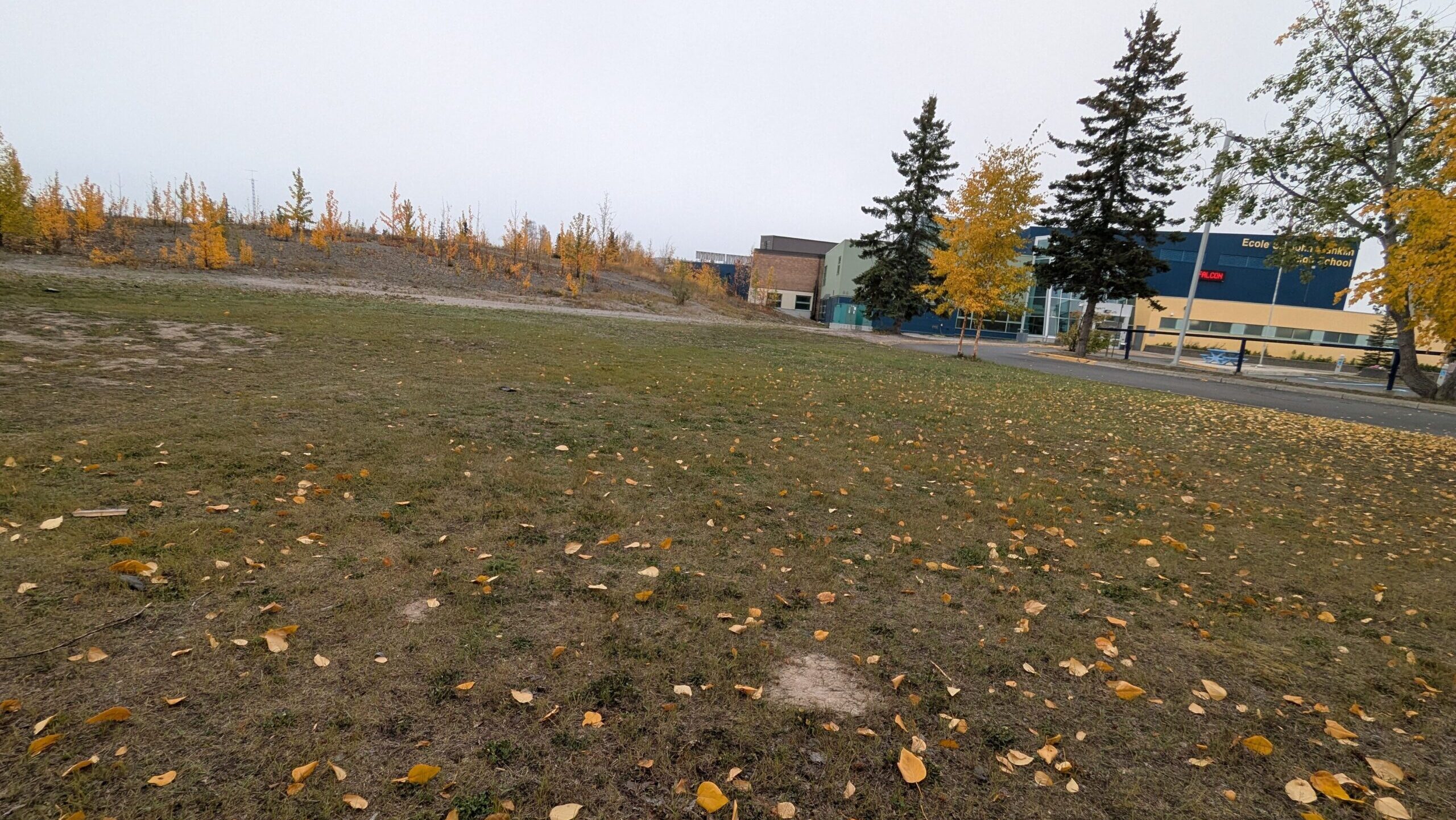

A group of Residential School Survivors are working with the NWT Arts Centre initiative, navigating red tape against the clock, to build a non-commercial art space on the former site of Akaitcho Hall.
Akaitcho Hall first opened its doors in the late 1950s, located next to Sir John Franklin High School on 52nd Avenue in the city of Yellowknife, and was demolished in the early 2000s.
Organizers said they have received positive responses from Survivors and from other stakeholders. The organizers face a complicated process that could potentially take 3 years, but they are working with GNWT reps to try to consolidate the process within the next 12 months, to prevent the loss of funding.
Bob Overvold, who is a Residential School Survivor and one of the co-founders of a Survivor Circle known as We Always Remember (WAR), are working with the group as they work to mobilize the TRC’s Calls to Action.
“We’ve been talking to them about trying to have a spot within their Art Centre, where we could have a residential school Resource Centre, where we could access everything to anything that has to do with the residential schools, to access government files on the experience, to access church files,” said Overvold.
Adrian Bell, Project Director, emphasized that the project to build the centre needs to be done in a respectful way that acknowledges the history of the site.
The group is proposing to build a non-commercial visual art focused Community Centre.
“That’s both the gallery, where art is displayed and the centre is the educational component workshops, opportunities for students to come in, sharing skills, all that type of type of thing.”
Earlier this year, organizers held engagement sessions to get feedback from community members, including Residential School Survivors
“With the history of it, having been a former residential school site, we recognise that there was a need to do much more outreach to determine community feelings,” he said.
“And in particular the feelings of Survivors of residential schools and their children and grandchildren. And so we set out to do that community consultation. We conducted a couple of public gatherings. One in person at the Tree of Peace in June and one online shortly following that first one, and it was really an opportunity for us to hear from people who had had experiences, at Akaitcho Hall and at other residential schools,” added Bell.
The Arts Centre, with WAR’s involvement, had two meetings, one in person and one virtual, with Residential School Survivors.
“I was one of them and because they wanted to know what these students, former students felt about an art centre being on that site,” said Overvold.
“The feedback certainly at the in-person meeting that I was at, which I spoke at length about, was no one was against the art centre being built on that site. And I’m told that the virtual meeting they had, that was the same outcome. Everyone thought it would be okay to build an art centre there,” he said.
Overvold spent about 4 years at Akaitcho Hall between 1961 to 1965 after being forced to attend other residential schools in the territory including the Aklavik residential school.
“There were some suggestions that within the centre, when built, there’ll be some things that recognise that this Art Centre is now on the land where there used to be a residential school, some acknowledgement about that,” said Overvold.
“We were hoping that we’re going to be able to build, or have within that Arts Centre, which is going to be a fairly big building, an area where we have a residential school resource Centre, as part of it,” he added.
Akaticho Hall first opened its doors in 1958 and was among one of the last documented residential schools to close its doors in the 1994. The hall was run by the federal government and later the territorial government. It housed both Indigenous and non-Indigenous students.
The school’s history included forcing Indigenous children away from their homes and communities in the territory. There, students are documented to have endured overcrowding and problematic living conditions.
Four students are known to have died there, as recorded in documents that the TRC were able to obtain.
The residential school system not only robbed Indigenous children of their childhood, taking them away from the safety of their homes within close-knit Indigenous communities in the N.W.T, but also damaged or destroyed links to Indigenous ways of life, by culture and language. Thousands of children did not make it back home.
The land of the Akaitcho Hall site is currently owned by the territorial government. The N.W.T. Art Centre group is trying to get the land transferred to them.
The WAR group is supporting them and is going to meet with one more group, YK1.
“We have a meeting with them in October, because they’ve told us there are other groups, who have expressed some interest in maybe eventually obtaining that land too,” said Overvold.
The process to transfer the land usually takes about 3 years, but the group is hoping to have the transfer happen sooner.
“They’re not willing to wait three years, they’d rather do it within the year or maybe a little more in a year. If not, then they would move on,” he said.
“So from the Arts Centre people, there’s some urgency for getting the land transferred to them. And we’re working on it,” he added.
Overvold said that the Yellowknives Dene leadership, along with WAR, are supporting the initiative.
Bell said that the proposed project has received “nothing but positive feedback” from the Department of Education and Culture, but the process to transfer the land is complicated.
“They’ve got a process that they have to go through to determine whether or not they can or will dispose of (the land) to us or to any group. And so now we’re working with them to really iron out what that process looks like and how long it will take because we don’t have forever to do this.”
The group has a funder, who is interested in backing the project but is not willing to wait for multiple years.
“So we sort of need to make a determination pretty soon here about how long this is going to take. And at some point we’ll have to make a go or no-go decision whether we potentially seek other locations if it’s not available or if it’s going to be too long to find out yes or no,” said Bell.
The group is hoping the process can be consolidated soon so that the project can move forward.
“We’ve got some upcoming meetings. We’re optimistic that we’re going to get some guidance as far as whether or not it might become available. We don’t expect anything concrete in the immediate future. We’re kind of setting a timeline here of the next nine to twelve months to be able to get a firm yes or no. That’s sort of the timeline that we’re working with.”
A crisis line is available for Survivors, Intergenerational Survivors and those affected by residential schools 24-hours a day, seven days a week at 1-866-925-4419. A counselling and crisis support is helpline is available 24 hours a day, seven days a week at 1-855-242-3310 or at www.hopeforwellness.ca.