FOTR is fundraising and setting its sights on a November event to help recover after a sudden storm and unseasonably cold weather this year presented added financial strains on the non profit. Carly McFadden, FOTR’s artistic director, says financial losses could have serious impacts on the grassroots arts-based initiative.
“It will have a significant financial impact on the year ahead and what programming could potentially look like or other additional programs that were normally running through a year like artists in residency programs and professional development programs and our affiliated events,” McFadden told True North FM.
The financial struggles many festivals are navigating are related to broader struggles affecting live music and artists, which include climate change, and rising costs, along with costs associated with tariffs, explained Erin Benjamin, president and CEO of the Canadian Live Music Association.
Benjamin pointed out that festivals like FOTR play an important role in communities and communities can play an important role in determining and defining their value, which can have implications on the fate of festivals.
Marvin T. Chan (aka Merv xx Gotti), FOTR Artist and organizer of the Trifecta festival and live music series in Saskatchewan. Chan pointed out that although there can be many expenses that are associated with festivals, like FOTR, the space created by organizers and artists together with festival goers is invaluable.
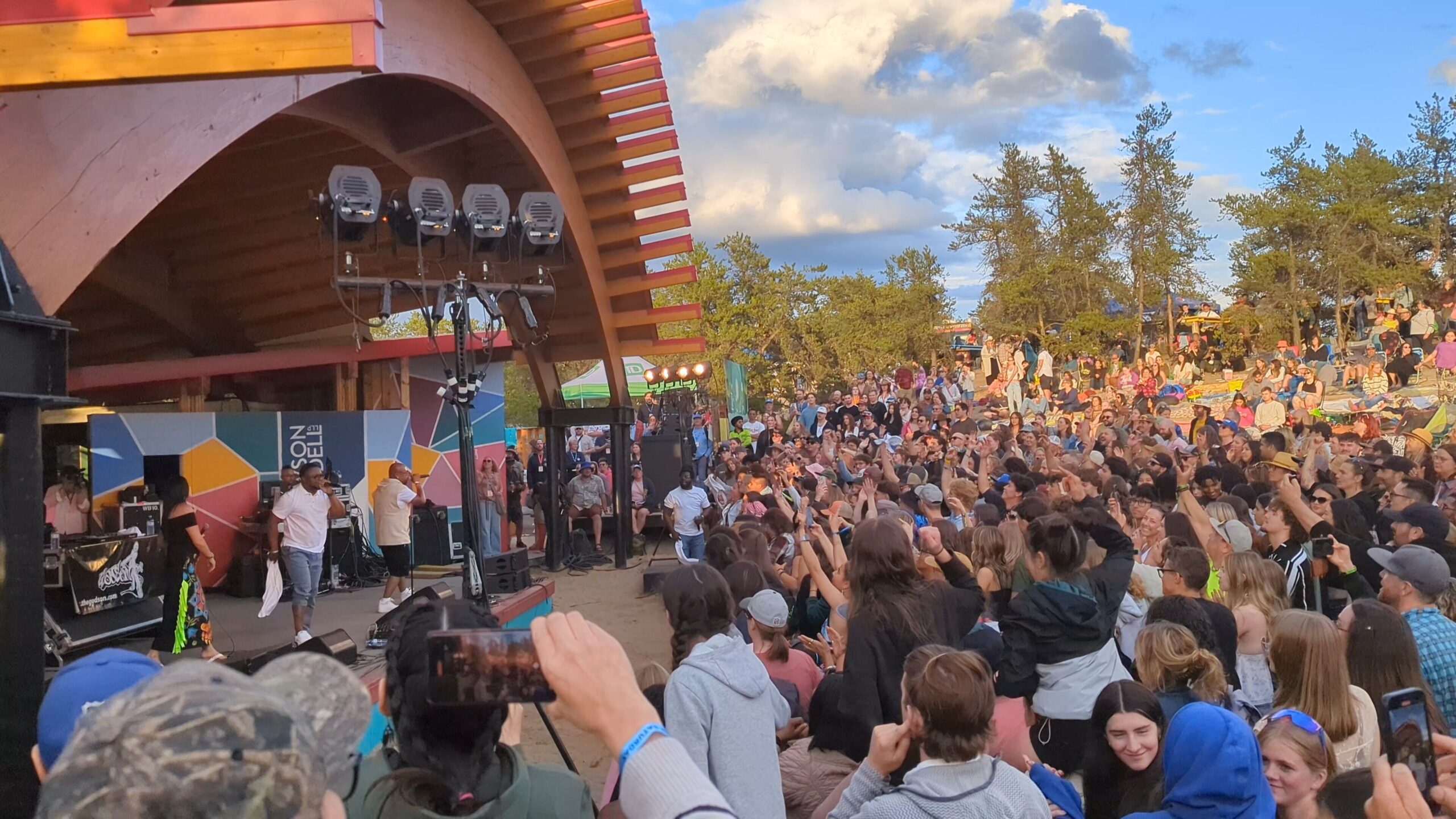
The festival took place between July 17 to 19 on the shores of Long Lake. Friday evening’s sudden thunderstorm brought an end to scheduled programs, including Warm On The Rocks, along with a whole night of beer garden sales. Then taking that together into account with Sunday’s unseasonably cold weather, amounted to a “significant” impact on the festival’s ability to break even as a non-profit.
Saturday’s warm weather and the support of the community helped to offset that financial blow.
“Saturday was fantastic. I have to say, people really came out and droves and we saw very strong community support and that was truly, truly heartwarming. It’s just that we were sort of bookended by bad weather and some bad luck I guess,” said McFadden.
“We’re a non-profit organization that operates on tight margins and with the rising costs of everything and the decrease in funding that we’re sort of seeing across the board. It’s certainly not been easy the last two years, but we’re doing our best to get things together. Our finances have actually improved over the last year, but we certainly have a long way to go before we’re back in the black and out of debt,” explained McFadden.
Some of the debt was expected as the festival has a long-term payment plan with the city of Yellowknife from their Mainstage renovation, explained McFadden.
“So there is some of that debt that we expected to have, but we are not in the best financial position right now, like many of our festival counterparts across the country. It’s a tough time to be in live music,” said McFadden.
“The factors that are contributing to the writing costs of hosting the festival are the same factors that are affecting the rising costs of living for folks across the country and across the world. The cost of travel is extremely high, which makes artists’ booking challenging.
Material supplies that would have come from the US that we’re no longer purchasing and other materials that have gone up in costs. Geopolitical politics across the globe are greatly affecting our bottom line as they are for most small businesses or other non-profits,” reflected McFadden.
Many festival goers showed their support by purchasing raffle tickets.
“We saw raffle sales go up by quite a bit this year. Actually, almost four times as much as we had in last year. Last year was the first year we ran the raffle, and this is our second year. We asked people to show up and they really did and we’re super grateful,” said McFadden.
“Our goal right now is to raise 10K via the donation that we’re asking for online,” said McFadden.
The fundraising opened on Monday and by Wednesday, $3,300 was raised. Anyone who would like to donate can find more information on the FOTR website.
“We are working on rolling out some sort of event, likely in November that will have some fundraising components to it as well,” explained McFadden.
“We’re also just sort of in the middle of shutting down from the festival and we need a sec where we can plan another event. So right now we are asking for donations, but there’ll be more information coming some activities and exciting other opportunities in the coming months,” added McFadden.
McFadden says that FOTR organizers are extremely grateful for the response they have received from the community.
“We’ve seen a lot of the support that we need to keep moving forward. We really haven’t experienced a lot of negativity. It’s just been a lot of care and concern and folks asking how they can help and what they can do and we’re very grateful to our community,” emphasized McFadden.
Playing festivals this summer, Chan often had a feeling of gratitude and happiness festivals like FOTR, Mariposa and others are still around because in his hometown of Regina their folk festival closed down this year due to financial problems.
Chan was recently reflecting with a bandmate on what these festivals, like FOTR mean. Chan told True North FM it really has to do with that “untangible” collective space of joy and hope, that feeling of peace in a time of uncertainty.
“Playing the festival and being there, it gave me that feeling again that everything’s going to be okay. And I feel like that’s what festivals really do for artists and for people in general. All the communities that gather and the people who come to festivals, they kind of go to festivals not just for music and not just for the community, but ultimately for that untangible feeling of everything will be okay in the world. I definitely felt that at Mariposa and I definitely felt that at Folk On The Rocks and that’s what’s important for keeping these festivals alive if we can.”
Alongside his work as an artist, Chan started a music festival in Saskatchewan with his friends called the Trifecta Music Festival, which they ran from 2014 to 2016 and it has continued on as a concert series.
“From my experience with like actually putting a festival together, I know everything that goes into it behind the scenes. Then you just get like a different kind of view, how difficult it is to keep those things running, and to keep the artists happy and to keep the festival true to what you designed it for,” Chan reflected.
“A lot of the time just flights and food and everything, costs money. And everyone knows those prices have been going up and that’s why festivals like Mariposa and Folk On The Rocks provide such good, healthy food for the artists and the accommodations. It’s such a huge help for artists, but then it makes me sad that that financial burden is obviously not easy for the festival to absorb,” said Chan.
Benjamin told True North FM that non-profits are facing a whole range of challenges similar to other small businesses in Canada.
“Everything from climate change, to funding scenarios and situations and things like inflation and of course the turmoil south of the border, directly impacting touring and Canadian artists’ access to other markets outside of Canada.”
Benjamin says the live music scene is “inconsistent and unpredictable” for especially for non-profits and small companies.
“The unpredictability in the market, sort of volatility, remains a factor and of course, inflation has been significant again for any small business. Everyone is feeling it. We’re feeling it at home and in our workplaces. And that is a real reality for the smaller companies in the Live music space. So things cost, more and no one wants to increase the cost of ticket prices. The concert going dollar in a fan’s wallet is already spread thin, we know and so where does that differential go? I mean if the venue is paying 20 percent more to put on a show, how are those costs covered, especially when ticket sales are maybe more last minute than ever.”
Benjamin suggests one thing music lovers and festival goers can do is to think about what makes those spaces where live music is played so special.
“Fans can really ask themselves why these, whether it’s a live event, a festival or a venue, why it matters to them. Why does this venue, this little live music Club, why does it matter to my quality of life where I live or the places that I travel to?”
These spaces have an impact on our quality of life, says Benjamin.
“I think Covid gave us a glimpse into that. When we weren’t able to gather for any reason, let alone a concert, it really immediately stood out and became very palpable – why these experiences matter so much, so fans can continue to buy tickets to shows, especially at smaller venues to go and see an artist that maybe you’ve never heard of, trust your local venue to be curating an incredible night of live music,” said Benjamin.
There are many ways music lovers can support festivals and live music, Benjamin pointed out.
“If you are able to sponsor a festival or event, volunteer, all the things that come to mind naturally, but here’s something that a lot of people don’t think about and that is talking to your local elected officials about why those spaces matter to you. Maybe you have nothing to do with live music. Maybe you’re a dentist or you own a grocery store or a corner store, or gas station, but you love live music. Helping elected officials understand why those spaces and places and that activity matters to you as a taxpayer and a voter can be extremely meaningful,” said Benjamin.
As an advocate for live music, Benjamin explained that together with fellow advocates, they spend a lot of time talking with the government about the potential of live music and what it represents economically, socially and culturally.
“It is so meaningful when others amplify that message for us. So that’s a great way fans and friends of live music can help. So it’s something to always keep in mind – why did they matter to me? And why do they matter to the place that I live? And I would just reinforce that thought because we’re all in this together and at a time in our history when Canadian culture and identity means so much, a lot of it can be found on the stages where live music is being performed today.”