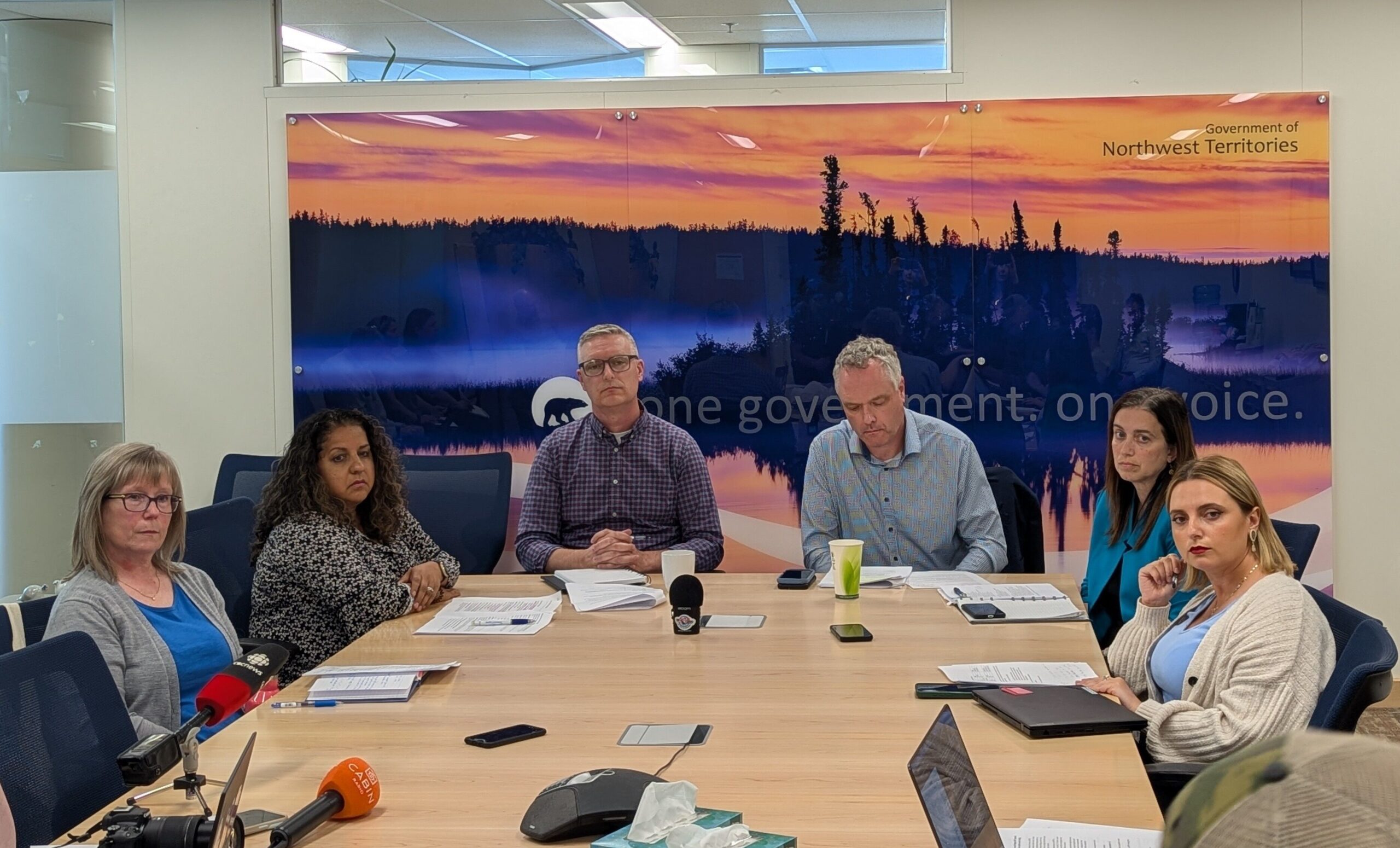

Findings of elevated lead levels in two Yellowknife area schools were first made public in May, but the findings of the latest report show a number of officials had some level of awareness of the situation months before precautions were taken in response. The report suggests “communication breakdown” and a lack of collaboration across departments were at the root cause of delays in responding to the water situation at the affected schools.
The latest report released this week was led by an independent investigator hired by GNWT. It contains three separate documents and over 200 pages of water testing results, interviews, maps and timelines.
The report is accessible on the Department of Education’s webpages
- Stantec report: Range Lake School
- Stantec report: William MacDonald School
- Report: Investigation into the Testing Program for Drinking Water in Northwest Territories Schools
- Monitoring and Testing of Water in the NWT
Representatives across departments that were involved said they hope that by making their mistakes transparent and by examining what went wrong, they can prevent it from happening again and “rebuild trust.”
Can they make so much that went wrong ‘right’? The final word rests with parents, guardians and the students.
Cayley Thomas, a lawyer with the investigation, who is the lead author of the latest report, found that representatives from GNWT’s Department of Infrastructure and the Department of Education were aware of initial results showing elevated lead in two YK schools for four months before YK1 blocked off sources of drinking water and parents/guardians were informed.
“Neither the results received in January, nor the results received on March 20, 2025 were reported to the OCPHO as they had requested.” The Office of the Chief Public Health Officer followed up in May, requesting the results, Thomas said.
In the report, Thomas pointed out that in 2018, representatives with the Department of Education and with the Department of Health and Social Services decided that schools needed to be tested annually for lead in drinking water.
Planning and costing estimates were prepared, but the project did not go ahead, noted Thomas in the report.
The report noted that it was not until October 2024, that the Department of Education requested and received approval to conduct single-sample testing of NWT schools.
“Because the estimated cost for conducting the tests and compiling the results was less than $8,000, and this was seen as a proactive step towards addressing an operational gap, ECE funded this activity internally,” said Thomas in the report.
When the testing did happen, the results that came in January were flagged for three schools.
Somehow, precautions to prevent the children from drinking the water were not taken and a period of months passed as officials waited for results from another round of testing.
According to the report, on Jan. 16, Infrastructure GNWT received test results showing three schools with heightened levels of lead in their water – Ecole William McDonald Middle School, Range Lake North School and NJ Macpherson. On Jan. 22 2025 ECE received the test results. INF and ECE decided to wait until retesting was done before taking steps, but even when the retesting was complete it was not until late May that steps were taken to inform parents and guardians.
The investigation also found that testing results were not reported to the medical authorities for about four months.
Samples from the three schools were retested and on March 11. Results came in on March 20, showing Ecole William McDonald Middle School and Range Lake North School’s water samples still showed elevated levels of lead.
“Neither the results received in January, nor the results received on March 20, 2025 were reported to the OCPHO as they had requested,” said Thomas.
The results received on March 20 “were not flagged for management attention” at the Department of Education or at the Department of Infrastructure.
The investigation found that testing results were not reported to Chief Public Health Officer until the office sent out a request on April 3. A few days later, the Department of Education provided the results. listed on a spreadsheet. On April 29, the Department of Education provided additional information showing 46 test results and results for the three re-tested schools. On May 8 the Office of the Chief Public Health Officer advised the Department of Education that they were very concerned.
Reps from the Department of Education said there was a lack of clear direction being provided to them on next steps. In response, the Chief Public Health Officer said that they had provided plain language, audience-specific information on April 30 and May 21. The Chief Public Health Officer said they were under the impression the Department of Education was “ignoring the information or choosing not to follow their advice,” noted Thomas in the report.
On May 26 a decision was made to implement further testing and YK1 blocked sources of drinking water at Ecole William McDonald Middle School and Range Lake North School, about four months after the initial results came in showing elevated lead levels.
Range Lake North’s samples showed elevated levels of both lead and copper in the first set of independent re-testing.
Flushing the water system cleared Range Lake North’s water system of contaminants.
After flushing out the water system, École William McDonald Middle School’s water samples still showed elevated levels of lead.
Two types of tests were conducted, beginning with random sampling and followed by a type of testing called “exceedance protocol” testing.
Random sampling is meant to reflect typical daytime water use of the water, while exceedance protocol testing is meant to “stress test” the system under conditions that are more likely to result in higher lead levels.
The results confirmed elevated levels of lead present in the samples at the flagged schools.
At McDonald Middle School in 10 of 13 water outlets sampled exceeded federal guidelines for lead in drinking water by up to about 100 times over Health Canada’s guidelines, in the medical room sink, while cafeteria sinks showed nearly up to about 10 times over the limit.
“The results from the potable water samples collected on June 12, 2025 from the selected fixtures at École William McDonald Middle School did not satisfy the applicable health-related federal guideline for lead in drinking water in 9/13 fixtures sampled in Tier 1 (first flush) samples and 10/13 fixtures sampled in Tier 2 (5-minute flush and 30-minute stagnation period) samples.
While the maximum allowable concentration for lead in drinking water in Canada is 5 µg/L (0.005 mg/L ), the latest data confirms that water samples showed levels as much as 100 times greater than that limit.
The medical room sink samples measured 566.5 µg/L under the ‘stress’ testing method and 105.7 µg/L using the ‘typical use’ method.
Ecole William McDonald Middle School’s cafeteria sink samples measured between 45.3 µg/L to 12.7 µg/L , the cafeteria kitchen sink showed levels of 50.3 µg/L to 19.4 µg/L, while food and lab sinks ranged from 39.1 µg/L to 8.6 µg/L.
The latest report also found that Ecole William McDonald Middle School’s water samples showed unacceptable pH levels and cloudiness caused by suspended particles in water.
“Field measurements for pH fell outside of the federal Guidelines for Canadian Drinking Water Quality – Operational Guidelines for select samples. Additionally, turbidity levels exceeded the federal Guidelines for Canadian Drinking Water Quality – Microbiological Parameters at the point of entry sample,” said Thomas in the report.
Flushing out the pipes could not remove lead and other contaminants from the water system at Ecole William McDonald Middle School. Officials said the source of contamination is likely within the plumbing system.